BiographyBiografía
Resume ↓Trayectoria ↓A life in search of freedomUna vida en busca de libertad
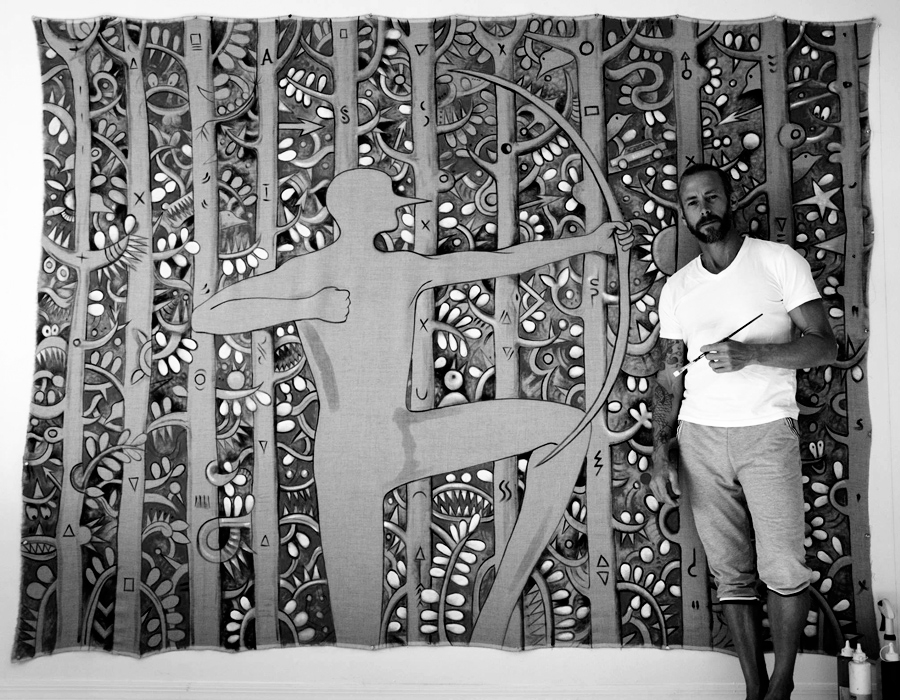
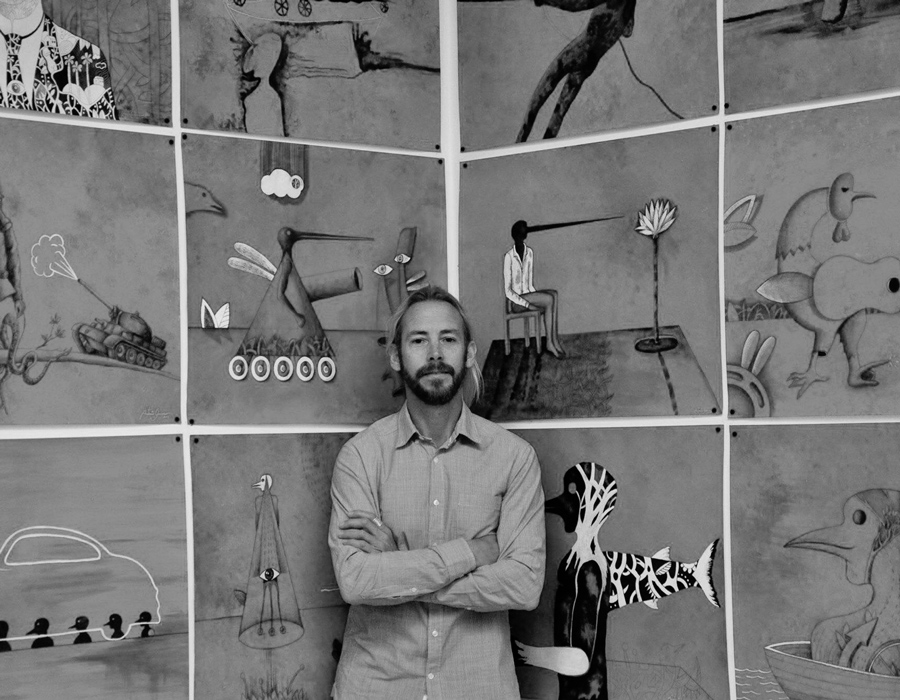
Antonio Guerrero is a Cuban American visual artist, born in Matanzas, Cuba, in 1968, who lives and works in Miami Beach, Florida. A self-taught painter and the founder of The Cuban Art Project, he brings the experience of an artisan, a young soldier in Africa and a man who crossed the sea on a handmade raft to an enduring artistic inquiry: how do we make a world in which the imagination remains free?
His story offers a way into the paintings, but it does not explain them away. Memory becomes possibility. Familiar forms enter unexpected relationships. What begins in a particular life opens onto questions of belonging, vulnerability and the mystery of being alive.
Antonio Guerrero es un artista visual cubanoamericano, nacido en Matanzas, Cuba, en 1968, que vive y trabaja en Miami Beach, Florida. Pintor autodidacta y fundador de The Cuban Art Project, reúne la experiencia del artesano, del joven soldado enviado a África y del hombre que cruzó el mar en una balsa construida con sus propias manos. De ese recorrido surge una pregunta que atraviesa su obra: ¿cómo crear un mundo en el que la imaginación siga siendo libre?
Su historia permite entrar en los cuadros, pero no los agota. La memoria se convierte en posibilidad. Las formas conocidas entablan relaciones imprevistas. Lo que nace de una vida concreta se abre a preguntas sobre la pertenencia, la vulnerabilidad y el misterio de estar vivos.
The imagination learns to makeLa imaginación aprende a hacer
Guerrero grew up in a household that encouraged artistic expression even when materials were difficult to obtain. Ideas were plentiful; the means to realize them were not. That distance between imagining and making provides a revealing introduction to his art. A shortage of materials need not become a shortage of vision.
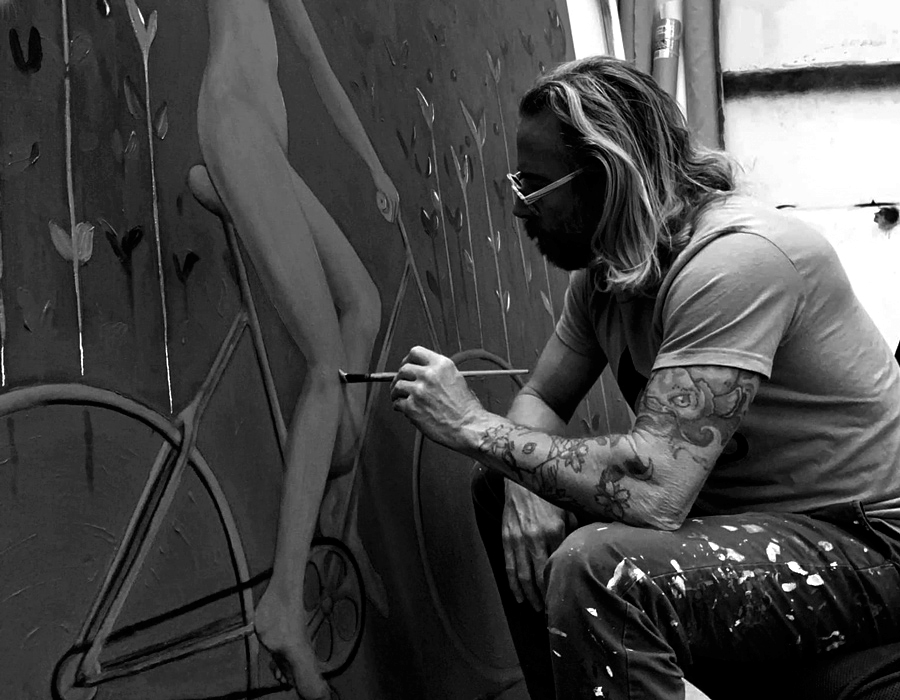
He describes his talent as “a gift from God.” Alongside that belief stands the practical intelligence of the artisan. His experience encompasses painting, engraving, woodcarving, sculpture and metalwork: disciplines in which an idea must contend with the resistance of a surface or a material. This is an artist whose relationship to invention is also a relationship to work. Before an imagined world can persuade the eye, someone must find a way to give it form.
Guerrero creció en un hogar que alentaba la expresión artística incluso cuando resultaba difícil conseguir materiales. Abundaban las ideas; escaseaban los medios para realizarlas. Esa distancia entre imaginar y hacer ofrece una primera clave de su pintura. La falta de recursos no tiene por qué convertirse en falta de visión.
Llama a su talento «un don de Dios». Junto a esa convicción está la inteligencia práctica del artesano. Su experiencia abarca la pintura, el grabado, la talla en madera, la escultura y el trabajo en metal: disciplinas en las que toda idea debe medirse con una superficie o con la resistencia de la materia. Su relación con la invención es también una relación con el trabajo. Antes de que un mundo imaginario pueda convencer a la mirada, alguien tiene que encontrar la manera de darle forma.
Africa: a different horizonÁfrica: otro horizonte
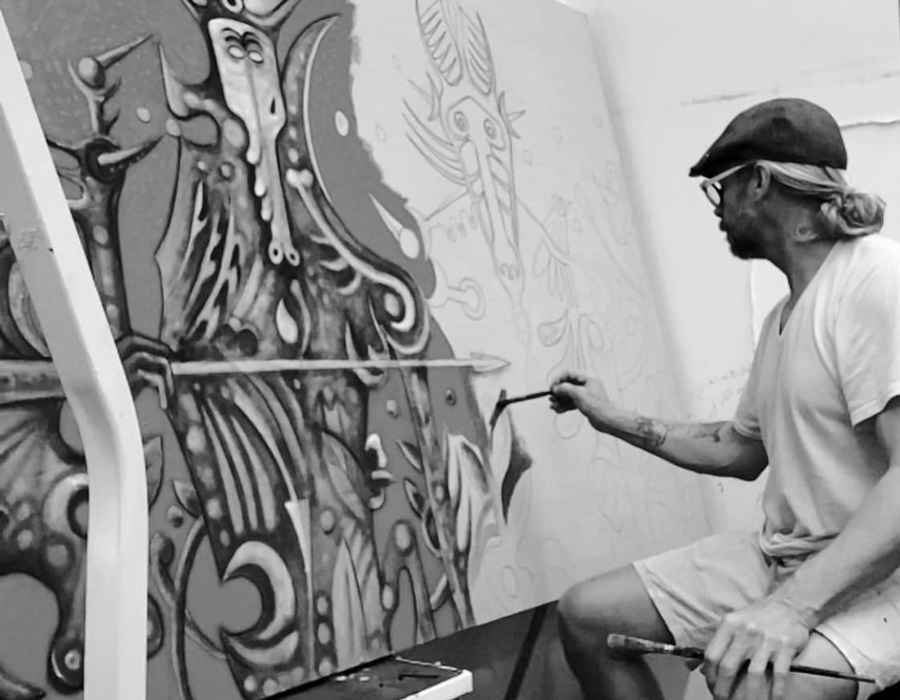
In 1986, Guerrero was drafted into the Cuban army and sent to Africa during the Ethiopian War. The people and scenes he encountered there awakened his interest in modern expressionism and encouraged his experiments with new visual forms. His paintings were exhibited at the Diré Dawa military base in 1987.
Africa was not an artistic pilgrimage he had freely chosen. Yet, within the constraints of military service, looking and painting opened a space of individual response. That distinction matters to his story. His formation took place within the era of the Cuban Revolution; his art would develop through an insistence on independence from its authority. The experience of a world beyond the island became part of an imagination that could no longer be contained by it.
En 1986, Guerrero fue reclutado por el ejército cubano y enviado a África durante la guerra de Etiopía. Las gentes y las escenas que encontró despertaron su interés por el expresionismo moderno y lo impulsaron a experimentar con nuevas formas visuales. Sus pinturas se expusieron en la base militar de Diré Dawa en 1987.
África no fue un viaje de formación artística elegido libremente. Sin embargo, dentro de las restricciones del servicio militar, mirar y pintar abrieron un espacio de respuesta individual. La diferencia importa. Su formación tuvo lugar en la época de la Revolución cubana; su obra se desarrollaría desde la exigencia de independencia frente a su autoridad. El contacto con un mundo más allá de la isla pasó a formar parte de una imaginación que ya no podía quedar encerrada en ella.
The crossing, and what came afterLa travesía y lo que vino después
After returning to Cuba in 1988, Guerrero resumed his work as an artisan. Increasingly oppressed by the government and troubled by worsening living conditions, he and two other men secretly designed and built a raft. They left the coast of Matanzas and spent five days at sea before being rescued and brought to the U.S.
The raft belongs first to lived experience, not to legend. But it also offers a compelling way to understand the artist: a man who builds his own vessel is already practicing the difficult art of imagining another future. The hands that made a means of escape would continue to make a language of their own.
In 1995, “Balseros del 92” (“The Rafters of ’92”), portraying Guerrero with his cousin and a friend fleeing Cuba, was exhibited at Vanidades Gallery, Miami. It formed part of a collection donated to the José Martí Foundation for FIU student scholarships. In 1996, his work was exhibited by U.S. Rep. Ileana Ros-Lehtinen in Washington, D.C., in “Cubans in Exile.” Personal memory had entered a wider conversation.
Al regresar a Cuba en 1988, Guerrero retomó su trabajo como artesano. Cada vez más oprimido por el gobierno y preocupado por el deterioro de las condiciones de vida, diseñó y construyó una balsa en secreto con otros dos hombres. Partieron de la costa de Matanzas y pasaron cinco días en el mar antes de ser rescatados y llevados a Estados Unidos.
La balsa pertenece, antes que nada, a la experiencia vivida, no a la leyenda. Pero también ofrece una imagen reveladora del artista: quien construye su propia embarcación ya está ejerciendo el difícil oficio de imaginar otro futuro. Las manos que hicieron posible la salida seguirían construyendo un lenguaje propio.
En 1995, «Balseros del 92» («The Rafters of ’92»), que retrata a Guerrero con su primo y un amigo huyendo de Cuba, se expuso en Vanidades Gallery, Miami. Formaba parte de una colección donada a la José Martí Foundation para financiar becas de estudiantes de FIU. En 1996, su trabajo fue exhibido por la representante estadounidense Ileana Ros-Lehtinen en Washington, D.C., en «Cubans in Exile». La memoria personal había entrado en una conversación más amplia.
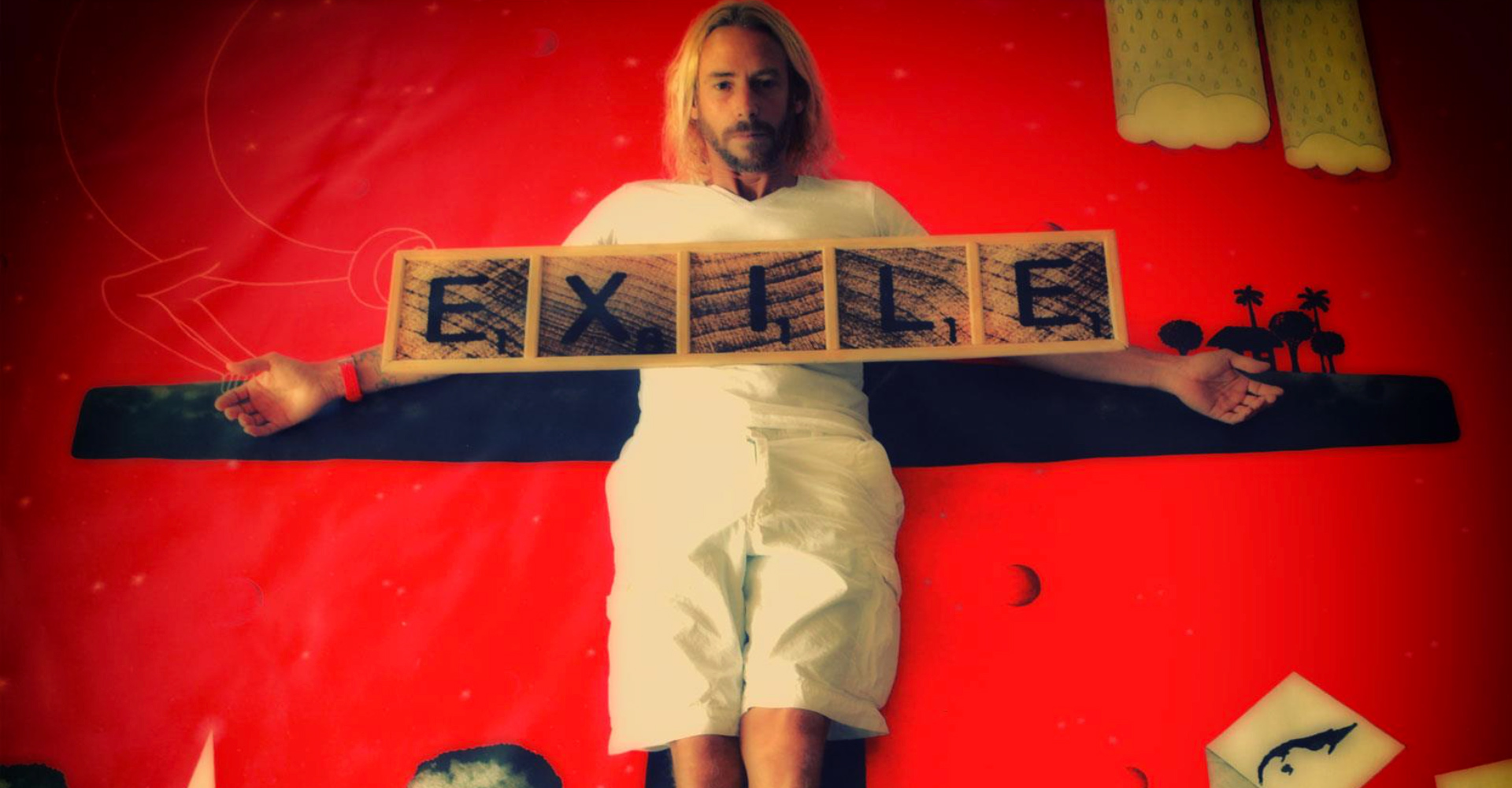
The hands that made a means of escape would continue to make a language of their own.Las manos que hicieron posible la salida seguirían construyendo un lenguaje propio.
A world recognizable—and unexpectedUn mundo reconocible e inesperado
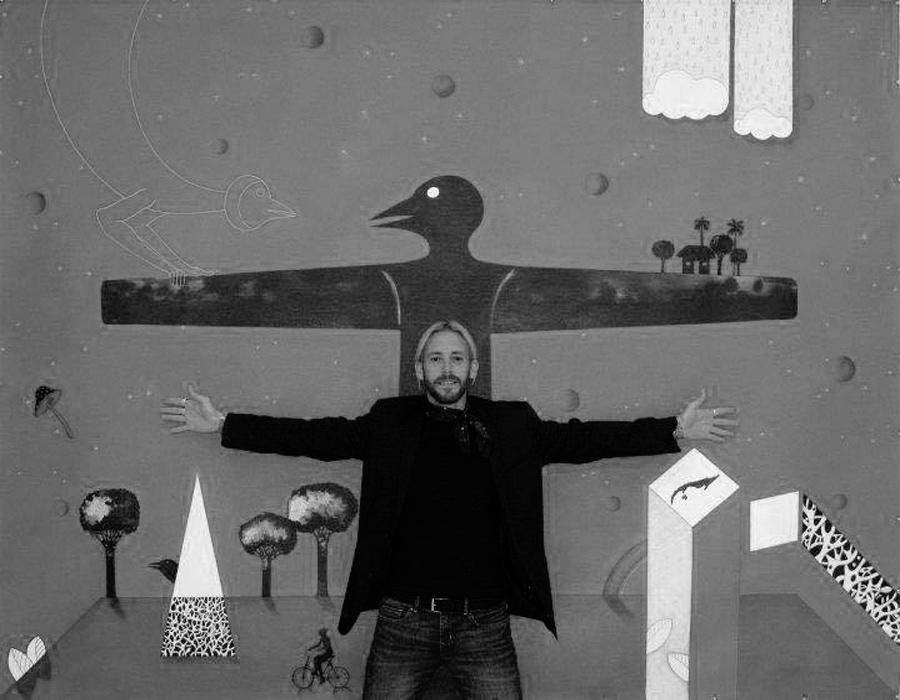
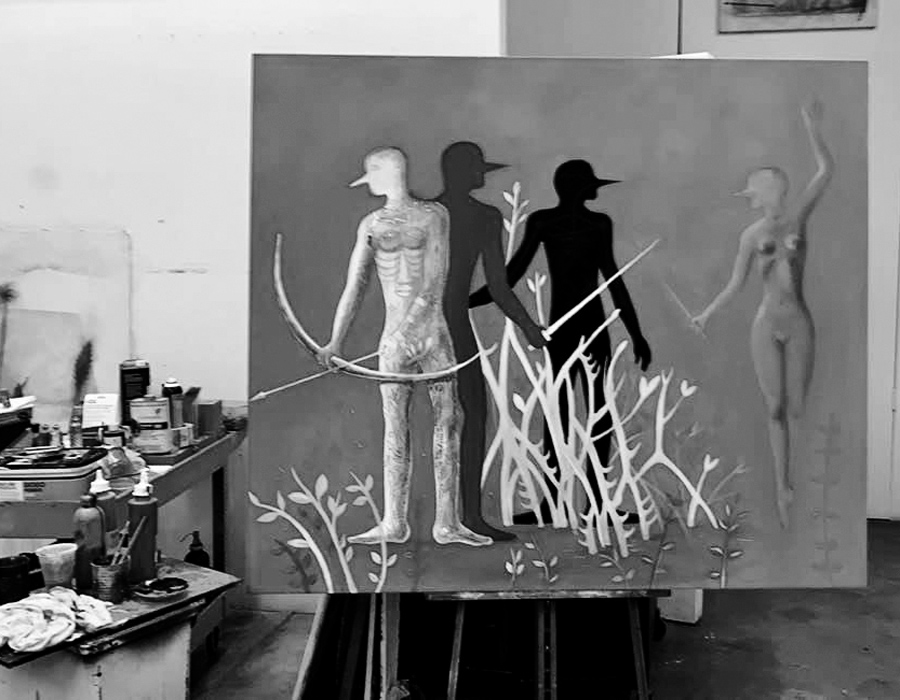
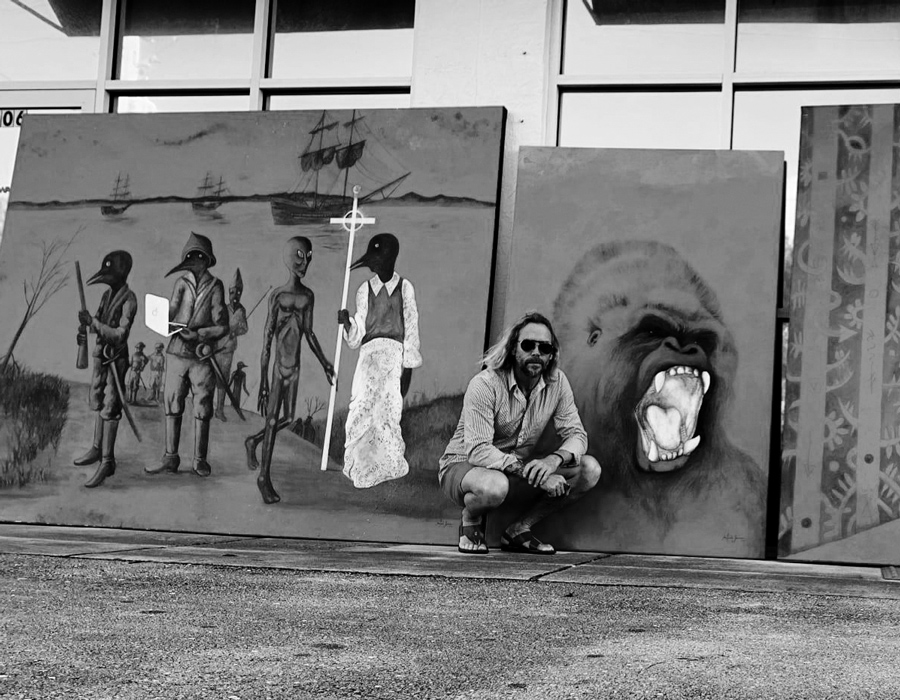
For Guerrero, exile is more than a biographical destination. It can also be understood as a vantage point: a place from which inherited assumptions become visible, and therefore open to change. His imaginary world allows recognizable shadows, rooted trees and convincing effects of light to coexist with relationships that unsettle our expectations. Realism draws us in; imagination changes the terms of our encounter.
He has compared the artist’s activity to programming with a sketchbook and brushes. The metaphor suggests a desire to intervene in perception rather than simply furnish it with attractive objects. His cosmic stage enlarges the questions raised by his own journey: what constrains us, what connects us, and what remains beyond explanation?
This is a productive way to approach his relationship to expressionism and the art of the Cuban diaspora. The painting need not reproduce the appearance of experience to convey its pressure. Nor must it remain a document of departure. A history of displacement becomes an invitation to imagine differently.
El exilio no es únicamente un destino en la biografía de Guerrero. También puede entenderse como un punto de observación: un lugar desde el cual las certezas heredadas se vuelven visibles y, por tanto, susceptibles de cambiar. En su mundo imaginario, las sombras reconocibles, los árboles arraigados en la tierra y los efectos convincentes de la luz conviven con relaciones que desajustan nuestras expectativas. El realismo nos acerca; la imaginación transforma el encuentro.
Guerrero ha comparado el trabajo del artista con el de un programador que utiliza cuaderno de dibujo y pinceles. La metáfora sugiere el deseo de intervenir en la percepción, no solo de ofrecerle objetos atractivos. Su escenario cósmico amplía las preguntas de su propia travesía: qué nos limita, qué nos vincula y qué permanece fuera de toda explicación.
Desde ahí resulta fértil pensar su relación con el expresionismo y con el arte de la diáspora cubana. La pintura no necesita reproducir la apariencia de una experiencia para transmitir su intensidad. Tampoco tiene que quedarse en documento de una partida. La historia del desarraigo se convierte en una invitación a imaginar de otra manera.
Red, the vessel, the open worldEl rojo, la embarcación, el mundo abierto
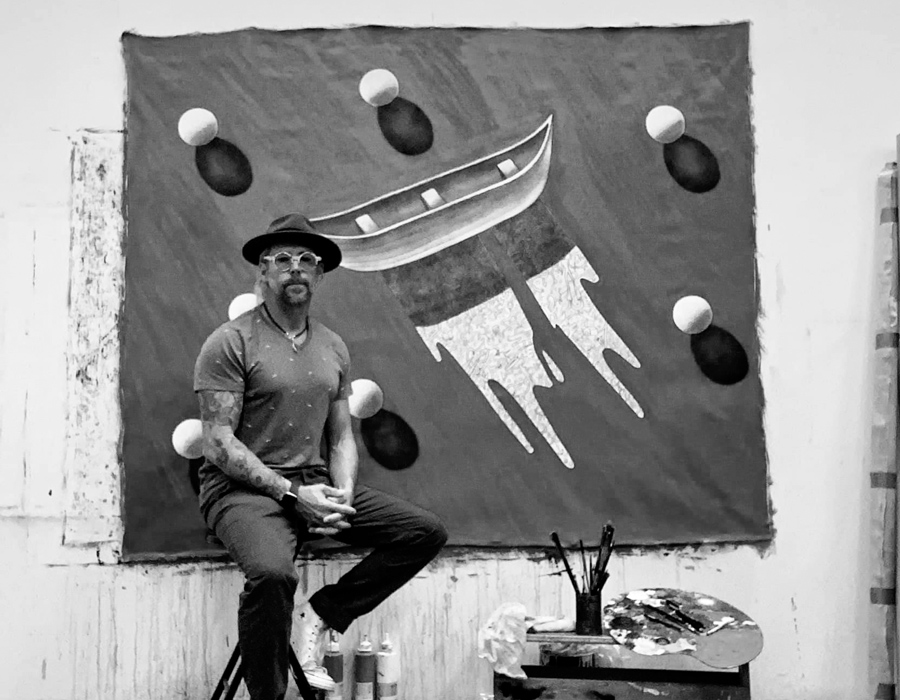
The exhibition titles “Red Planet” (Wynwood, 2015), “Tailor Boat” (Vargas Gallery, Miami, 2016) and “Red Works” (LCAA, Fort Myers, 2016) bring together an evocative vocabulary: color, vessel, world. Read through the story of his crossing, the boat can suggest both vulnerability and agency—a fragile construction that nevertheless makes movement possible.
Red, in turn, invites more than one interpretation. It may register as vitality, urgency, danger or desire; no single political or emotional reading need exhaust it. These are possibilities for the viewer, not a fixed dictionary of the artist’s intentions. The strength of such a visual language lies in its capacity to sustain attention after the first impression has passed.
Los títulos «Red Planet» (Wynwood, 2015), «Tailor Boat» (Vargas Gallery, Miami, 2016) y «Red Works» (LCAA, Fort Myers, 2016) reúnen un vocabulario sugerente: color, embarcación, mundo. Leída a través de la historia de su travesía, la barca puede hablar a la vez de vulnerabilidad y de voluntad: una construcción frágil que, pese a todo, permite avanzar.
El rojo, por su parte, admite más de una lectura. Puede sentirse como vitalidad, urgencia, peligro o deseo; ninguna interpretación política o emocional tiene por qué agotarlo. Son posibilidades para quien mira, no un diccionario cerrado de las intenciones del artista. La fuerza de un lenguaje así reside en su capacidad de sostener la atención cuando ya ha pasado el primer impacto.
A personal vision, an international recordUna visión personal, una trayectoria internacional
Guerrero’s exhibition history includes “Punctum contra Punctum II” at the Georgian National Museum / National Gallery, Tbilisi (2013); Florida Contemporary at The Baker Museum (2014); and the Art Museum of Myrtle Beach (2015). His work is in the permanent collection of The Baker Museum, Naples, FL (2020). In 2012, he was one of four Cuban artists chosen by Bacardi for its 150th anniversary; his work is also in its permanent collection.
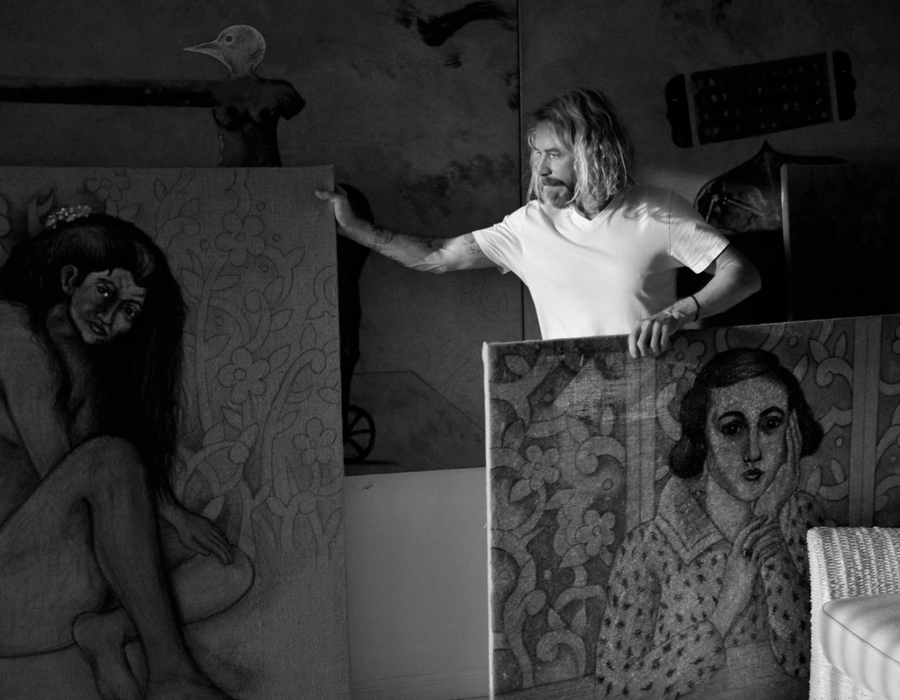
These milestones provide context for a practice whose center remains personal. The most persuasive reason to spend time with a Guerrero painting is the encounter itself: the pull of an image, the questions it opens, and the meanings that emerge through looking. His biography gives that encounter depth without dictating what a collector must see.
To live with this work is to make room for an imagination that has refused confinement. The crossing is part of its history. The possibility of another world remains its invitation.
Su trayectoria expositiva incluye «Punctum contra Punctum II», Georgian National Museum / National Gallery, Tbilisi (2013); Florida Contemporary, The Baker Museum (2014); y Art Museum of Myrtle Beach (2015). Su obra forma parte de la colección permanente de The Baker Museum, Naples, FL (2020). En 2012 fue uno de los cuatro artistas cubanos elegidos por Bacardi para su 150.º aniversario; su trabajo también está en su colección permanente.
Estos hitos sitúan una práctica cuyo centro sigue siendo personal. La razón más convincente para detenerse ante un Guerrero es el encuentro mismo: la atracción de una imagen, las preguntas que abre y los sentidos que aparecen al mirar. La biografía le da profundidad a ese encuentro sin imponerle al coleccionista una interpretación.
Convivir con esta obra es hacerle sitio a una imaginación que se ha negado al encierro. La travesía forma parte de su historia. La posibilidad de otro mundo sigue siendo su invitación.